

The Empty Space
January - March 2026
Conceptual artist & painter, Wei Yuan reflects on the paradox and the possibility of the empty space'


With a background in both technical drawing and painting alongside conceptual approaches, Wei Yuan’s practice combines intellectual rigour, exacting observation with a profound commitment to emotional sincerity. For Yuan, painting is not simply an end in itself, but a ‘thinking device: an interface for structural experimentation’. Her work is concerned with ‘everything’ and ‘nearly nothing’ as well as the dialogue between them. In depicting emptiness, she challenges the very notion: Wei Yuan’s emptiness is dynamic, charged with potential, and unignorably alive.
The current exhibition at ArtSpace5-7 offers continuity over Wei Yuan’s long-standing interests and marks a significant departure in terms of the scale, scope and confidence of her artistic practice. Yuan’s minutely observed surfaces are extended by bolder gestural strokes and her characteristically muted colour palate incorporates a warmer, more optimistic, glow.
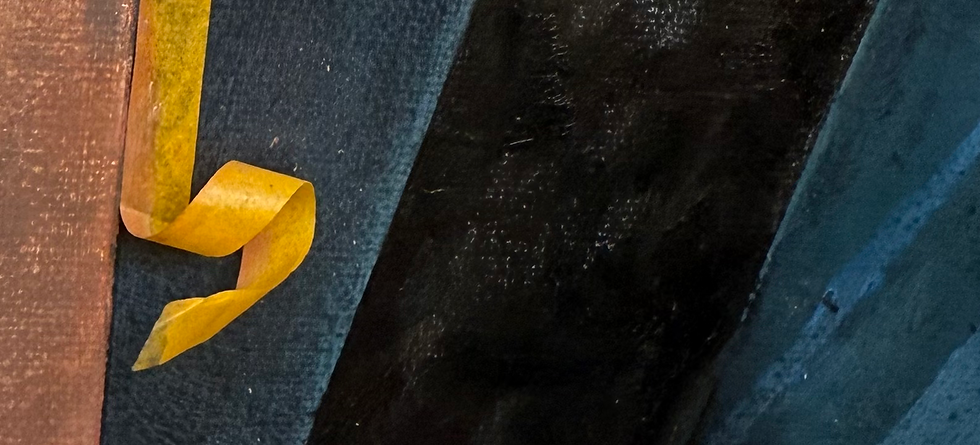
Through her subtle, delicate, technically masterful and multi-layered paintings, often incorporating unexpected and playful elements, like artist’s masking tape, Yuan explores the paradox and possibility of The Empty Space. As in the seminal book of the same title by Peter Brook (1976) ‘a man walks across this empty space whilst someone else is watching him, and this is all is for an act of theatre to be engaged’, her work suggests something is ‘about to begin’ and pregnant with possibility.
The current exhibition identifies, and cherishes, the extraordinary within the mundane. It operates at what Bill Brown, in his pioneering 2001 essay on ‘Thing Theory’, describes as ‘the threshold between the nameable and unnameable, the figurable and unfigurable, the identifiable and unidentifiable’: the conceptual hinterland of the ‘thing’, the object with a (decidedly nonhuman) life of its own. Wei’s paintings force us to not only look, but to question – not just the object but their context – the space within space.
Building on her earlier series Mind the Gap, in which she explores the conceptual spaces between people, places and roles using non-narrative compositions and abstract visual forms, Yuan responds to, and reflects on, her migratory life, experiences of displacement and exclusion, shared by so many people who are forced to move across boundaries and adapt. Her paintings reflect the tensions of participation in unknown and uncertain contexts, the challenges of communicating across cultures, the barriers of a foreign language and the difficulties of responding to unfamiliar environments – the need to balance not only who we are, but who we are perceived, or expected, to be. Refusing categorisation, Yuan fluidly moves from the figurative to the conceptual, reflecting the reality of her surroundings with a deeply philosophical, conceptual mindset.
Yuan is fascinated by ‘tiny stories’, seemingly mundane, minute and often feminised details of everyday existence. More recently, maternal experience and the domestic space have been central preoccupations in her work. Her recent series, Alchemy, considers the multi-layered implication of children’s toys, incorporates unexpected elements such as gem and rhinestone stickers used for children’s crafts, challenging notions of what constitutes value, as well as the underlying materials and their implied meaning. Akin to the pre-occupations of Virginia Woolf’s ‘A room of One’s Own’ (1929), based on seminal lectures delivered at Cambridge’s women-only Colleges, Newnham and Girton, Yuan interrogates the need for a dedicated physical space, enabled by economic independence, as a necessity for creative production. In this, her current exhibition is a direct extension of the preceding group show, Four corners of the World at ArtSpace5-7 in 2025.
In her forensic treatment of everyday objects, a curtain, a chair, or a doll’s house, she offers a quietly subversive critique of the role and treatment of women and especially female artists, historically under-represented in the art world and under-valued by the art market. Subtly, and radically, she asserts a female perspective on subject, object and space.
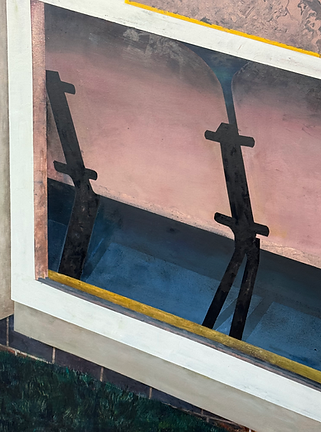
The current exhibition presents a series of large-scale and brand new paintings alongside a selection of smaller new and previous works, highlighting the breadth of Yuan’s practice. On the one hand, she challenges us with abstract architectures which feel inhabited, and on the other hand, confronts us with busy interiors of grand houses or museums, bustling with objects but which paradoxically feel devoid of human habitation or obvious function.
This exhibition therefore represents a significant departure for Yuan, as she embraces a larger, more ambitious scale for her expressions and creative practice. There is a confident maturity in both depicting ‘The Empty Space’ and also, in filling it.
The timing of the current exhibition at ArtSpace5-7 consciously coincides with the beginning of New Year in the Gregorian calendar, and the interval of the Chinese New Year in the traditional lunisolar calendar: a metaphorical ‘Empty Space’ between two beginnings. For many of us, the prospect of the year-to-come represents a pristine ‘Empty Space’ within which to construct our (equally pristine and idealised) future selves. The New Year is ‘empty’ in the sense of ‘xu’, a concept from Daoist philosophy, denotes a kind of emptiness that enables transformation, inviting us to generate meaning for ourselves. Looking ahead to the New Year, we become the architects of our own lives. We construct this space, as it constructs us.
The Empty Space explores the inner world, the outer world and the relationship between the two. It represents serendipity, fortune and all the twists and turns of identity, the spaces we inhabit, and ultimately, of being.
Read Wei Yuan's artist bio here.


